PhD teaching assignments
The PhD degree programme must, according to the PhD ministerial order, include teaching activities or an other form of dissemination of knowledge.
At Department of Chemistry you participate in the teaching of the students by carrying out theoretical, laboratory, and computer exercises as well as study café (TØ, LØ, CØ and SC).
- If you are a paid PhD-student (PhD fellowship) the teaching salary is included in your salary according to your contract of employment.
- If you are PhD-student on SU (PhD scholarship) you are employed in a temporary teaching position and is paid accordingly.
How much do I have to teach?
How much do I have to teach?
As a general rule all PhD-students at Department of Chemistry teach 140 hours per semester through the whole PhD, unless stated otherwise in the contract.
- It is often possible to teach more in one semester and then less in another semester (e.g. double teaching, 280 hours, in one semester and then no teaching in a later semester). However, it depends on the course and how many other PhD students who plan to teach that semester.
- As a general rule, the amount of hours given for a specific teaching task is: "confrontation time" x 2.5. This then includes time for preparation/subsequent processing (e.g. grading of reports).
- PhD students are allowed 1 semester (i.e. 140 hours) free of teaching, which most PhDs choose to place at the end of the PhD when the thesis has to be written, but it is of course up to the student to decide.
How are the teaching tasks allocated?
How are the teaching tasks allocated?
How are the teaching tasks allocated?
At Department of Chemistry, the teaching allocation is managed by Lene Conley and Ida Johanne Haugaard Sørensen.
When it is time to plan the coming semester (November/May) and you will be contacted by e-mail and you will receive instructions of how to indicate your prioritized course wishes. Wishes from the course responsibles are also obtained.
In December/June a preliminary list of teaching tasks is distributed. Most PhD students will be allotted teaching tasks in accordance with the submitted requests or similar.
You are always welcome to contact Lene or Ida if you have any questions
Teaching exemption
Teaching exemption
One semester free of teaching
All PhD fellows are granted one semester’s exemption from this work obligation without reduction in payment. If you want to use your one semester free of teaching (140 hours) it is important to inform Lene Conley or Ida Johanne Haugaard Sørensen. You can do this in the comment box in the form, where you register your teaching requests. It is not enough just to omit filling out the form!
- If you e.g. have to hand in your thesis at July 31st, you can use your teaching free semester in the spring.
- If you e.g. have to hand in your thesis at October 31st, you can use your teaching free semester in half of the spring semester (70 hours) and the rest of the autumn semester (70 hours)
You are also free to use your teaching-free semester (140 hours) at any other time during your PhD.
Teaching exemption due to stay abroad
If your are going on a long-term stay abroad it is possible to get teaching exemption for a maximum of 6 months in connection with your stay abroad.
You must send a application by e-mail to the PhD-partner at GSNS with CC to the supervisor.
Please note: if you are going abroad in your par A (on SU scholarship + a separate teaching contract) you cannot get exemption from GSNS. Contact Lene Conley or Ida Johanne Haugaard Sørensen instead.
From Rules & Regulations:
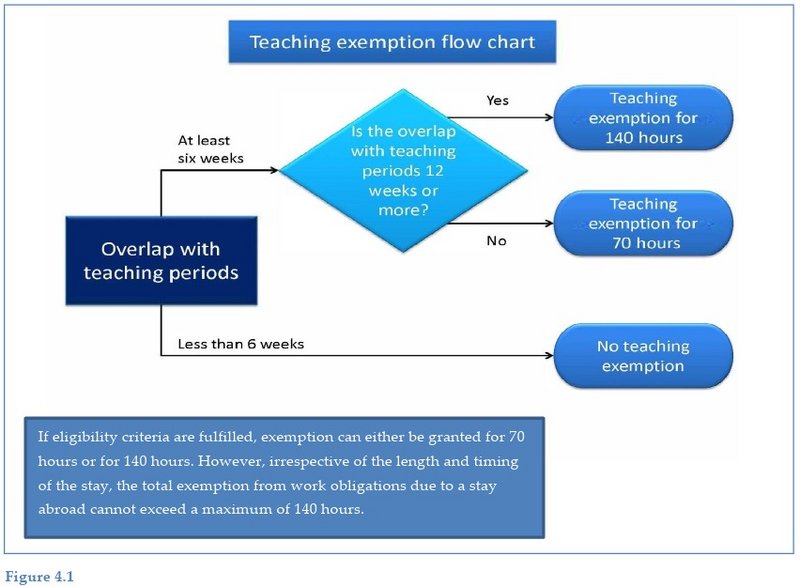
PhD fellows may get exemption with no reduction in payment during extended stays in another research environment for up to six months in addition to the general one semester’s exemption. Usually the stay takes place abroad, but if relevant to the project it may also take place in Denmark, e.g. in an industrial research environment. To be eligible for exemption from 70 hours (i.e. half a semester) of teaching obligations, the stay(s) must overlap with at least six full weeks of teaching periods (not necessarily in a single teaching semester). To be eligible for exemption from 140 hours (i.e. one semester), the stay(s) must overlap with at least 12 full weeks of teaching periods see Figure 4.1. Thus, if eligibility criteria are fulfilled, exemption can either be granted for 70 hours or for 140 hours. However, irrespective of the length and timing of the stay, the total exemption from work obligations due to a stay abroad cannot exceed a maximum of 140 hours. If the stay abroad lasts more than six months and/or 140 hours of work obligations or does not overlap with teaching periods as described below, the PhD student can either make use of the general one semester’s exemption or must compensate by additional work before or after the stay.
Instructor tasks
Instructor tasks
What are the tasks of an instructor?
- The primary task of an instructor is to prepare and hold TØ/LØ/CØ and correction of reports and assignments. It is the course responsible VIP who is responsible for planning TØ/LØ/CØ i.e. decide which exercises will be used during the course, possibly though discussions with instructors.
- The instructors have to register the presence/absence of students at obligatory exercises and register if the students hand in the obligatory assignments/reports. These registrations have to be handed over to the course responsible teacher at the end of the course.
- The instructors may be required to hold "question hours" for the students
- Furthermore the instructors will act as sparring partners for the other course instructors and for the course responsible teacher, e.g feed-back on TØ/LØ/CØ and suggestions for improvements.
- The instructor must be present during the course, and as a general rule must minimize absence due to participation in conferences, field-studies, vacation etc. during the course. However, it is allowed to switch teaching with another instructor when absence cannot be avoided.
- Absence due to illness: the instructors switch classes mutually. When ill, the instructor is responsible for contacting other instructors and/or backfill. When there is only 1 instructor in the course, a solution is found together with the course responsible teacher. Regarding long-term illness: contact responsible teacher, Lene Conley and GSNS.
- Before the start of the course there may be preliminary meetings which the instructor must participate in.
- Before laboratory exercises it may be necessary to perform the experiments as preparation.
The role of the backfill instructor
If possible one extra instructor (backfill) is allocated for the large first year courses (Inorganic Chemistry I and Organic Chemistry I) for both TØ and LØ to assist the course responsible teacher with primarily administrative tasks.
At the preliminary meeting an experienced instructor is chosen for this role, and this backfill instructor has the following tasks:
- To make a list of contact information (email and phone numbers) of all the instructors, and to note who teaches which class. This class distribution list can be sent to Lene Conley ot Ida Johanne Haugaard Sørensen.
- When an instructor is ill, the backfill must find a substitute, either the backfill or another instructor
- To act as a sparring partner for the other instructors, especially new PhD-instructors. This is with regard to correction of assignments/reports and other questions.
- Feedback to course responsible teacher (i.e. collect relevant information from other instructors)
- Arrange meetings with the course responsible teacher and the instructors when necessary. It is recommended that every course is ended with a debriefing for course evaluation.
- Collect the registers of absence from the other instructors for the course responsible teacher
- Be present at study cafe when possible, if needed
- Keep track of hours spent on the backfill tasks

